The demand for professional root removal across Far North Queensland has reached unprecedented levels as property owners face mounting pressure from insurers and local authorities. Effective root removal is no longer just an aesthetic landscaping preference, but a critical structural requirement for protecting underground plumbing and building foundations in the tropical climate of Cairns. Recent discussions surrounding cultural heritage and the deep connection to the native landscape have highlighted the delicate balance required when managing urban vegetation in this region. The unique soil profiles of Cairns, combined with an intense annual wet season, cause subterranean networks to expand rapidly, often bringing them into direct conflict with residential and commercial infrastructure. This article examines the current regulatory landscape, the severe financial implications of ignoring invasive tree growth, and the strict technical standards governing subterranean tree management. Readers will learn how rising insurance premiums dictate property maintenance, what the physical extraction process actually involves under Australian Standards, and the exact steps required to assess subterranean damage before it compromises structural integrity. By understanding the intersection of local council overlays, cultural preservation, and structural risk management, property managers and residential homeowners can make highly informed decisions about their vegetation assets.
Balancing Cultural Heritage and Property Risks in 2026
The conversation surrounding vegetation management in Far North Queensland is deeply intertwined with cultural heritage and a profound respect for the native landscape. On the 25th of March 2026, the National Indigenous Times reported that the Cairns Indigenous Art Fair mourned the passing of respected artist, designer, and cultural leader Simone Arnol. Her significant cultural contributions and deep connection to the Far North Queensland landscape serve as a powerful reminder of the intrinsic value of native flora to the region's identity. This deep respect for the natural environment means that any intervention, including necessary root removal, must be approached with immense sensitivity and a clear understanding of the ecological and cultural context. Property owners in the region must constantly balance this deep respect for native heritage with the practical, everyday realities of property risk management. The challenge becomes particularly acute when established native trees, which hold significant cultural and ecological value, begin to threaten essential urban infrastructure.
As urban density increases across the region, the conflict between preserving significant vegetation and protecting structural assets intensifies dramatically. Recent Freshwater development triggers calls for protections of trees, highlighting the strong community demand for careful environmental stewardship and the preservation of the urban canopy. However, when subterranean growth compromises building foundations, cracks concrete driveways, or infiltrates municipal sewer lines, targeted interventions become entirely unavoidable. The loss of urban canopy is a highly sensitive issue, with industry reports indicating Cairns loses 80 percent of its mature street trees in certain redeveloped zones due to preventable subterranean conflicts that were ignored until full tree extraction was the only option. Managing this delicate balance requires property managers to implement proactive subterranean strategies rather than reactive, destructive clearing. By employing highly targeted root removal methods, it is possible to mitigate severe structural risks while successfully preserving the above-ground cultural and ecological value of the region's most significant vegetation.
How Rising Premiums Affect Cairns Property Owners
The financial landscape for property management in Far North Queensland has shifted dramatically as insurance providers reassess the massive risks associated with established vegetation. Cairns Regional Council enforces strict vegetation management overlays that dictate exactly how and when property owners can interact with significant trees. These municipal regulations frequently intersect with stringent property insurance requirements, creating a highly complex compliance environment for commercial and residential stakeholders alike. When invasive subterranean growth threatens concrete slab foundations or underground plumbing networks, the financial consequences of delaying root removal can be exceptionally severe. Insurance companies are increasingly scrutinizing claims related to structural subsidence and pipe blockages, often denying coverage entirely if the property owner failed to perform adequate preventative maintenance on the surrounding vegetation.
The cost of repairing a cracked concrete slab or replacing a collapsed terracotta sewer main far exceeds the initial investment required for proactive subterranean management. Furthermore, properties located in high-risk zones face escalating annual premiums if mature trees are situated too close to primary structures without certified subterranean barriers actively in place. A recent industry overview from Cairns Tree Lopping Pros Provides Tree Removal Services emphasizes that insurers now demand documented evidence of professional risk mitigation before underwriting policies for older properties. Property managers who ignore the early warning signs of subterranean intrusion, such as lifted pavers, cracked brick veneer, or slow-draining plumbing, expose themselves to immense out-of-pocket expenses. The tropical climate of Cairns accelerates vegetation growth significantly, meaning a minor subterranean issue can evolve into a major structural failure within a single wet season. Consequently, timely and compliant root removal is essential for maintaining both the physical integrity of the building and the validity of the associated insurance policy.
The Technical Process of Professional Root Removal
Executing professional root removal in Cairns requires strict adherence to technical specifications and national guidelines, specifically AS 4970-2009 Protection of trees on development sites. The process begins with a comprehensive subterranean assessment to map the exact location and diameter of the offending growth relative to the main trunk and nearby infrastructure. This diagnostic phase determines the Tree Protection Zone and the Structural Root Zone, establishing whether the extraction will compromise the stability of the tree. Once mapped, the physical root removal process heavily relies on non-destructive digging techniques, primarily hydro-excavation. Hydro-excavation uses highly pressurized water combined with an industrial vacuum system to safely displace the surrounding soil without severing or tearing the subterranean network. This method exposes the problem area cleanly, allowing practitioners to make precise, surgical cuts using specialized sterilization equipment. Clean cuts are paramount because they promote rapid compartmentalization, preventing the introduction of soil-borne pathogens like Phytophthora that thrive in the humid Cairns environment.
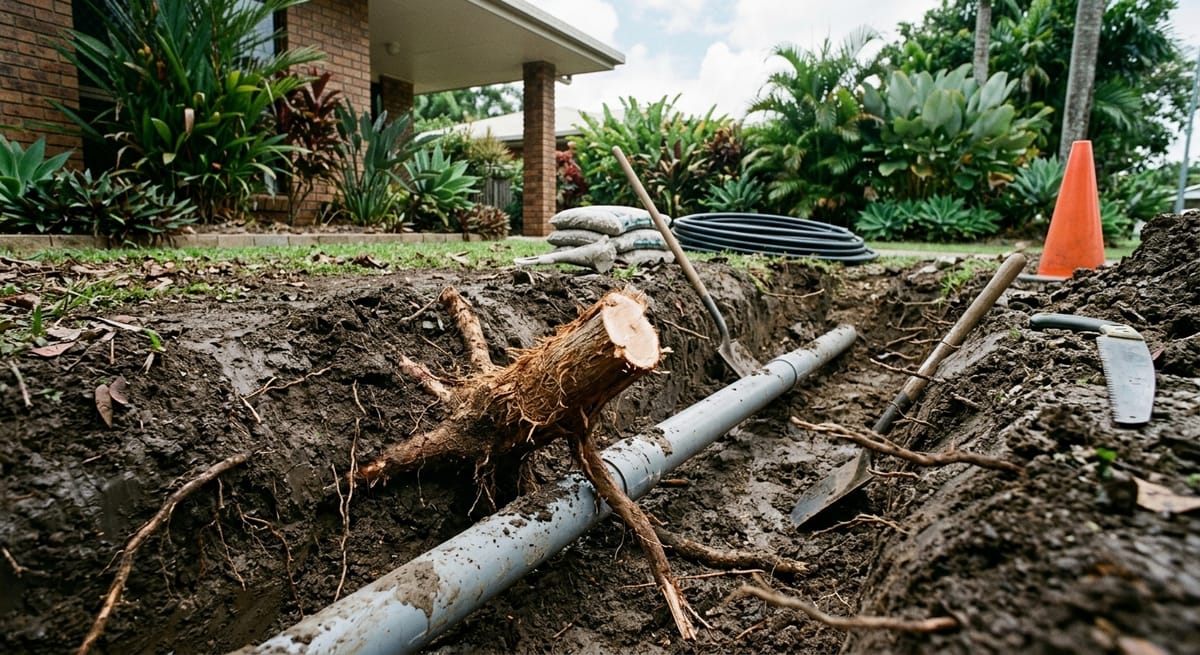
After the targeted root removal is complete, the installation of high-density polyethylene barriers is critical for long-term prevention. These physical barriers are inserted vertically into the excavated trench, typically to a depth of 1000mm to 1500mm, effectively redirecting future growth downwards and away from vulnerable foundations or pipes. The quality of this installation separates compliant work from substandard attempts. Quality workmanship is characterized by clean surgical cuts, the precise alignment of the high-density polyethylene barrier with absolutely no gaps, and the careful backfilling of the trench to maintain correct soil compaction. In contrast, poor work often involves indiscriminate hacking with excavators or chainsaws, which tears the vascular tissue, shatters the timber, and destabilizes the entire organism.
When this critical work is performed incorrectly, the failure points are significant, highly visible, and costly. Improper extraction can lead to immediate tree mortality or, more dangerously, a total loss of structural anchorage that results in the tree falling during a cyclonic event. Furthermore, failing to install the barrier to the correct depth allows the growth to simply bypass the obstacle underneath, leading to recurrent infrastructure damage within a few short years. According to technical resources like the #1 Rated Tree Loppers Cairns, adherence to AS 4970-2009 is entirely non-negotiable for ensuring the long-term viability of the retained vegetation while permanently resolving the conflict with the built environment. Proper execution protects the property, preserves the tree, and satisfies the rigorous demands of local municipal overlays.
Immediate Steps for Assessing Root Damage
The immediate assessment of subterranean damage requires careful observation and thorough documentation before any physical intervention occurs. Property owners must photograph all visible signs of intrusion, including cracked exterior brickwork, lifted concrete pavers, uneven driveway slabs, and blocked drainage grates. Documenting these issues prior to touching the site is absolutely critical for validating future insurance claims and demonstrating compliance with local council regulations. Detailed photographic evidence establishes a clear timeline of the damage, which is essential when planning a formal root removal project and communicating the severity of the issue to technical assessors.
Following the initial visual assessment, the next critical phase is checking local municipal overlays to determine if a specific permit is required for the work in Cairns. Property owners must consult the Cairns Regional Council website to verify if the vegetation is protected under a significant tree register or a neighborhood character overlay. Commencing physical root removal without the appropriate council approval can result in severe financial penalties and legal action under state vegetation laws. Understanding that permit processing times in Far North Queensland can take several weeks is vital for planning the project timeline accurately and avoiding unnecessary delays.
Obtaining comprehensive quotes is the third necessary step, and property managers must ensure that every proposal details the exact scope of the extraction. A proper quote for root removal must explicitly list the use of non-destructive digging methods, the specific grade of high-density polyethylene barriers to be installed, and the provision of a final compliance report. If a contractor submits a vague quote missing these critical technical specifications, it strongly signals a lack of professional capability and an ignorance of Australian Standards. Comparing at least three detailed quotes allows the property owner to evaluate the proposed methodology rather than just selecting the lowest price.
Verifying the credentials of the chosen contractor is a non-negotiable requirement in Queensland, where specific licensing governs structural landscaping and arboriculture. Property owners must confirm that the operator holds the appropriate Queensland Building and Construction Commission license for the proposed scope of work. This verification should be conducted through the official state register to ensure the license is active and free of any past disciplinary actions. Furthermore, the contractor must provide a certificate of currency for comprehensive public liability insurance to protect the property against accidental damage during the excavation process.
Time-sensitive environmental factors play a massive role in the success of subterranean interventions, particularly given the extreme weather patterns experienced in Far North Queensland. The Cairns wet season introduces heavy rainfall that severely saturates the soil, dramatically increasing the risk of tree destabilization if major structural anchors are severed during this period. Performing extensive root removal work during peak monsoon conditions can lead to catastrophic failure, soil erosion, and compromised barrier installations. Planning the intervention during the drier months ensures stable soil conditions and a much safer operating environment for the heavy machinery required.
Recognizing when professional arborist help is non-negotiable is the final and most important step in the assessment process. While a homeowner might safely prune a small surface feeder in a garden bed, any intervention involving structural anchors, proximity to underground utilities, or trees exceeding three meters in height demands licensed expertise. Attempting a do-it-yourself approach on major subterranean networks is highly dangerous, illegal under many council overlays, and will immediately void home insurance policies if structural damage occurs. The threshold for professional involvement is crossed the moment the growth interacts with concrete foundations, sewer mains, or protected native species.
Compliance and Standards in Tree Management
Navigating the regulatory framework for vegetation management in Queensland requires a strict adherence to established compliance standards and state legislation. When a property faces significant subterranean conflicts, the initial diagnostic phase must be conducted by an AQF Level 5 Arborist. This level of qualification is legally required to produce formal tree risk assessments and detailed subterranean mapping reports that satisfy local council requirements. The arborist determines the maximum allowable extraction volume that can be safely performed without compromising the structural integrity of the specimen. Proceeding with major root removal without this formal assessment exposes the property owner to immense liability. The legal and financial consequences of non-compliant or substandard work are severe, often resulting in massive council fines for illegal clearing under the Vegetation Management Act 1999.
Furthermore, if a tree fails and damages adjacent property because its structural anchors were incorrectly severed, the liability falls squarely on the property owner who authorized the non-compliant work. This is why engaging proper Arborist And Tree Health services is critical before breaking ground. The installation of subterranean barriers also carries significant warranty and insurance implications. If high-density polyethylene barriers are installed without proper certification or fail to meet the depth specifications outlined in the engineering report, any subsequent damage to the building foundation will likely not be covered by the property insurer. Insurers require documented proof that the mitigation work was performed to standard.
Property managers overseeing large complexes must be particularly vigilant, often requiring comprehensive Commercial And Managed Property Services to ensure all compliance boxes are checked across multiple sites simultaneously. Resources such as the Top 10 Best Rated Tree Removals in Cairns list often highlight operators who maintain the necessary Queensland Building and Construction Commission licensing and Safe Work Australia compliance requirements. Ultimately, professional compliance protects the long-term financial value of the property, ensures public safety, and provides the necessary legal documentation to satisfy both municipal regulators and insurance underwriters.
Frequently Asked Questions
Does home insurance cover tree root damage to pipes in Queensland?
Home insurance policies in Queensland generally do not cover damage caused by tree roots to pipes as a standard inclusion. This type of damage is often considered a maintenance issue or gradual deterioration, which most standard policies exclude. Some comprehensive policies might offer limited coverage for sudden and accidental damage, but it's crucial to review your specific policy wording or consult with your insurer directly to understand the extent of your coverage and any applicable exclusions or limitations regarding tree root damage.
How much does professional root removal cost in Cairns?
The cost of professional root removal in Cairns can vary significantly depending on several factors, including the size and type of tree, the extent of the root system, the location of the roots (e.g., in pipes, foundations, or garden beds), and the accessibility of the area. Simple root cutting might be a few hundred dollars, while extensive excavation or specialized plumbing work to clear roots from pipes could range from $500 to several thousand dollars. Obtaining multiple quotes from local arborists or plumbers is recommended for an accurate estimate.
Can I cut tree roots without killing the tree?
Yes, it is often possible to cut tree roots without killing the tree, but it requires careful consideration and professional expertise. The extent to which roots can be cut depends on the tree's species, age, overall health, and the percentage of its root system being removed. Severing too many major structural roots can destabilize the tree or compromise its ability to absorb water and nutrients, leading to decline or even death. Consulting a qualified arborist is essential to assess the situation and determine a safe and effective approach.
Do I need Cairns Regional Council approval to remove tree roots?
Generally, you do not need Cairns Regional Council approval solely for removing tree roots, especially if they are within your private property and not part of a protected tree. However, if the tree itself is protected under a local planning scheme, a heritage overlay, or is a significant tree on public land, then any work affecting its roots, including removal, may require council approval. It's always advisable to check with the Cairns Regional Council's planning department if you are unsure about the status of a particular tree or its roots.
How do you permanently stop tree roots from growing back into plumbing?
To permanently stop tree roots from growing back into plumbing, a multi-faceted approach is usually required. Simply cutting the roots is a temporary solution. Long-term prevention involves repairing or replacing damaged pipes with root-resistant materials, such as PVC or cast iron with sealed joints. Additionally, installing root barriers made of solid plastic or metal sheets can physically block roots from reaching the pipe. Chemical treatments can also be used to inhibit root growth in the vicinity of pipes, but these should be applied cautiously and professionally to avoid harming the tree or surrounding environment.
Conclusion
The increasing frequency of infrastructure damage and rising insurance premiums underscore the critical importance of proactive vegetation management in Far North Queensland. Navigating the complexities of local council overlays, cultural heritage considerations, and stringent building codes requires a thoroughly professional approach to subterranean conflicts. Effective root removal is an essential investment that protects valuable building foundations, preserves underground plumbing, and ensures compliance with Australian Standards. By engaging qualified arborists and utilizing non-destructive excavation techniques, property owners can mitigate severe financial risks while maintaining the ecological value of their landscapes. If you suspect subterranean intrusion is threatening your property, arrange a formal assessment with a licensed arborist immediately to document the site and determine the safest course of action before structural damage occurs.
More Stump and Root Services Services at Arbor Tree Removal Cairns
For more information about Stump and Root Services services at Arbor Tree Removal Cairns, explore the pages below: